
On this page
How is a seamless gutter made and hung?
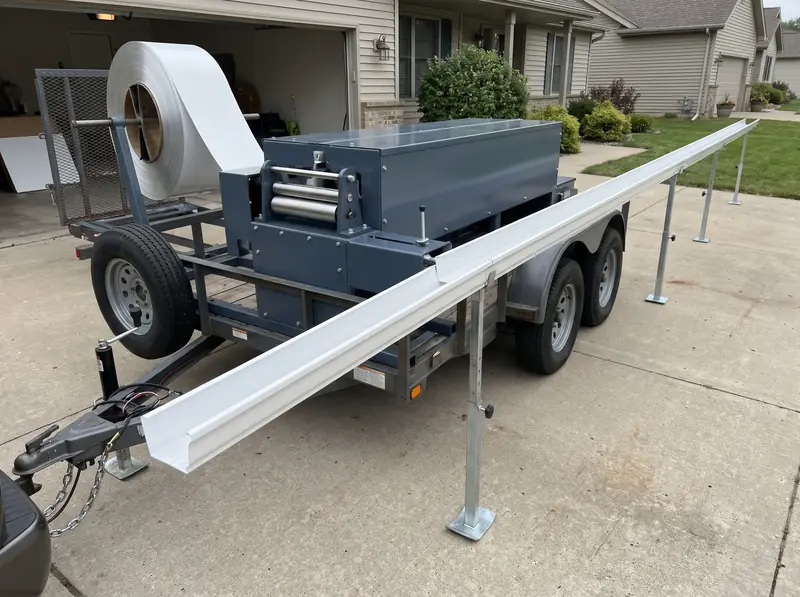
The contractor arrives with a gutter machine on a trailer and a coil of painted aluminum, steel or copper. Each wall is measured, and the machine rolls the coil through a series of forming wheels into the K-style or half-round profile, cutting it to length as it comes out. The finished piece is carried up, set on hidden hangers screwed through the fascia into the rafter tails, and pitched toward its outlet. Corners are cut as miters, riveted and sealed; end caps are crimped and sealed; outlets are cut into the bottom and fitted with drop sleeves for the downspouts.
The result is a single continuous piece along each wall. On a typical two-story Ashburn colonial that means a handful of joints in total, against dozens on a sectional system.
Why do seamless gutters matter in Loudoun's climate?
Every joint in a gutter is sealed with a flexible sealant, and every sealant line eventually fails. Northern Virginia is hard on sealant: roofs bake in July and August, then cycle through freeze and thaw from December to February. Washington Dulles International Airport averages 21.1 inches of snow a season, according to the National Weather Service's Dulles snowfall records, and much of it melts and refreezes on the eaves. A sectional gutter with a connector every 10 or 20 feet gives that cycle many places to open a leak. A seamless run gives it only the corners.
The nearest long-running weather record is at Washington Dulles International Airport, a few miles south of Ashburn. The National Weather Service's Dulles precipitation table gives a 1991 to 2020 normal of 43.24 inches a year, with May the wettest month at 4.72 inches, and its snowfall records put the normal season at 21.1 inches. Much of the summer total arrives in thunderstorms that put a lot of water into the gutter in a short time. Seamless runs carry it to the outlet without leaking along the way, but they still need to be the right size and to have enough downspouts.
What should an Ashburn seamless gutter quote include?
| Item | What to look for |
|---|---|
| Profile and size | 5-inch or 6-inch K-style, or half-round, per run |
| Metal and gauge | .032 aluminum is a sound default; steel or copper if chosen |
| Color | Matched to trim or to the association's approved list |
| Hangers | Hidden hangers, about every 2 feet, into rafter tails |
| Downspouts | Count and size (3x4 preferred), with elbow and strap details |
| Discharge | Where each downspout drains: extension, splash block or buried line |
| Removal | Taking down and hauling away the old gutters |
| Fascia | Price per foot for replacing any soft board found |
Which houses around Ashburn get seamless gutters?
Nearly all of them. The planned communities of eastern Loudoun, from Ashburn Farm and Ashburn Village to Broadlands and Brambleton, are mostly two-story colonials and townhouses that suit seamless K-style aluminum. The exceptions are older houses in Leesburg and Purcellville, where half-round gutters may suit the architecture better, and accent runs where owners choose copper. Even half-round and copper are usually formed on site now.
Seamless versus sectional at a glance
| Seamless | Sectional | |
|---|---|---|
| Joints | Corners, ends and outlets only | Every 10 or 20 feet as well |
| Typical leak points | Few | Many |
| Who installs | Contractor with a machine | Often homeowners |
| Colors | Wide range of coil colors | Limited store stock |
| Cost | A little more per foot | Less per foot |
The seamless vs sectional guide compares the two in more depth.
Terms that come up
| Term | What it means on an Ashburn house |
|---|---|
| Seamless gutter | Gutter rolled to length on site from a coil of painted metal, so each wall gets one piece and the only joints are at corners and ends. |
| Sectional gutter | Gutter sold in 10 or 20-foot pieces and joined with slip connectors and sealant. Each joint is a future leak. |
| K-style gutter | The standard residential profile, flat at the back with a decorative ogee front. It holds more water than a half-round of the same width. |
| Coil stock | The roll of factory-painted aluminum, steel or copper fed through the gutter machine on the contractor's trailer. |
| Hidden hanger | A bracket that clips under the gutter's front lip and screws through the back into the fascia. It cannot be seen from the ground. |
| Miter | A corner joint where two runs meet, cut, riveted and sealed. Corners are where most drips begin. |
| Outlet | The hole in the gutter bottom that feeds a downspout, normally fitted with a riveted drop sleeve. |
| Slope | The slight fall a gutter needs toward its outlet, typically about a quarter inch for every 10 feet of run. |