
On this page
- Reston at a glance
- What is Reston like for gutter work?
- Which gutter setup suits houses in Reston?
- What does the weather around Dulles do to gutters in Reston?
- How much gutter does a typical house in Reston take?
- Which gutter problems turn up in Reston?
- Roads, streams and landmarks around Reston
- 5-inch or 6-inch for a house in Reston?
- What signs say the gutters in Reston need attention?
- Nearby areas
Reston at a glance
| Type | Census-designated place, Fairfax County |
| Founded | April 10, 1964, by Robert E. Simon |
| Population (2020) | 63,226 |
| Lakes | Anne, Audubon, Newport, Thoreau |
| Tree canopy | About half the total area |
| Typical gutter work | Guards, cleaning, replacement, cluster and townhouse drainage |
What is Reston like for gutter work?
Reston was founded on April 10, 1964, by Robert E. Simon, who named it from his initials. The 2020 census counted 63,226 residents. Reston has four man-made lakes, Anne, Audubon, Newport and Thoreau, and was planned around village centers. It is heavily wooded: tree canopy covers about half its area, and homeowners generally need permission from the Design Review Board to remove trees over 4 inches in diameter. The Reston Association looks after parks, common grounds and trails, and the W&OD Trail runs through.
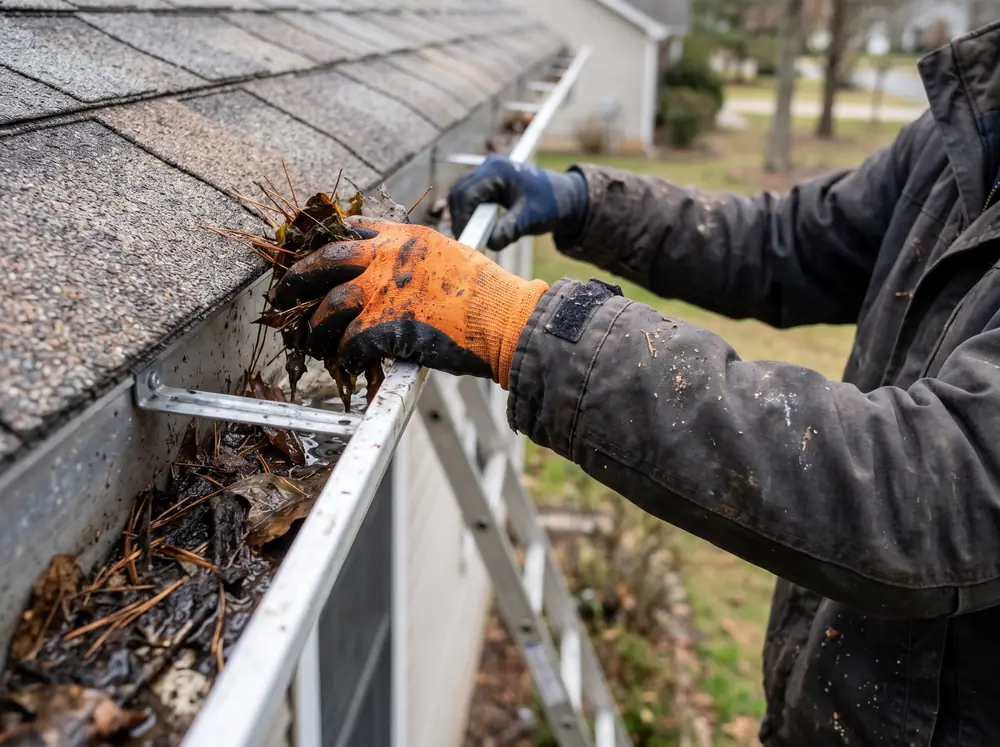
For gutters, that canopy is the defining factor. Houses tucked into the woods catch leaves, seeds, twigs and pollen through most of the year, and outlets clog fast. Guards, particularly micro-mesh, are common, and gutters without them may need cleaning three or four times a year. Since trees are protected, guards are often a more realistic answer than taking trees down.
The housing ranges from 1960s and 1970s clusters and townhouses, some with distinctive roof lines, to single-family houses and newer condominiums. Older clusters may have original or second-generation gutters, soft fascia and downspouts that drain onto shared paths. Changes usually go through cluster associations and Reston's design review. Reston is in Fairfax County, so Loudoun rules do not apply.
Which gutter setup suits houses in Reston?
Reston's wooded clusters and houses suit these choices.
| Common choice in Reston | |
|---|---|
| Gutter | Seamless 5-inch or 6-inch depending on the roof |
| Metal | .032 aluminum in approved colors |
| Downspouts | 3x4 |
| Fastening | Hidden hangers about every 2 feet |
| Guards | Micro-mesh almost everywhere under canopy |
| Cleaning | Three or four times a year without guards |
| Discharge | Extensions away from paths and neighbors |
| Main risks | Constant debris, older fascia, shared drainage |
| Rules | Fairfax County; cluster associations and Reston design review |
What does the weather around Dulles do to gutters in Reston?
Ashburn and its neighbors share one long-term weather record: Washington Dulles International Airport. The National Weather Service's Dulles precipitation table lists a 1991 to 2020 normal of 43.24 inches a year, spread fairly evenly through the months, with May the wettest. Snow averages 21.1 inches a season, and the Dulles snowfall records show how heavy single storms can be: 32.4 inches over February 5 and 6, 2010, and 29.3 inches over January 22 and 23, 2016. Wind is the third test. The June 29, 2012 derecho left 36,117 Dominion customers in Loudoun without power by early the next morning, according to Ashburn Patch, and fallen limbs did much of the damage.
| Season | What the gutters in Reston go through |
|---|---|
| Spring (March to May) | Rain builds from about 3.5 inches in March to 4.72 in May, the wettest month at Dulles; pollen, flowers and seeds fall from the canopy |
| Summer (June to August) | 3.5 to 4.3 inches a month, much of it in short, hard thunderstorms; storms bring down twigs and leaves into gutters |
| Fall (September to November) | About 3.1 to 3.9 inches a month; a long, heavy leaf fall under the canopy |
| Winter (December to February) | 2.6 to 3.3 inches a month plus most of the 21-inch normal snowfall; falling limbs in ice and wind |
How much gutter does a typical house in Reston take?
Gutters are priced by the installed foot, so the length of the eaves sets most of the cost. The table multiplies national installed ranges from Angi by eave lengths that are typical for local houses. It shows scale only, not a quote.
| House | Typical eave length | Gutter | National range installed |
|---|---|---|---|
| Cluster townhouse | 40 to 80 ft | 5-inch seamless aluminum | roughly $360 to $1,040 |
| Single-family house | 140 to 200 ft | 5-inch seamless aluminum | roughly $1,260 to $2,600 |
| Two-story house | 170 to 230 ft | 6-inch seamless aluminum | roughly $2,040 to $4,140 |
Tearing off old gutters, fascia repairs, extra downspouts, buried drain lines, guards and tall or awkward walls all push these figures up.
Which gutter problems turn up in Reston?
| House | What goes wrong | Usual fix |
|---|---|---|
| Houses under canopy | Constant clogging | Micro-mesh guards |
| 1960s and 1970s clusters | Aging gutters, soft fascia | Replacement, wood repair |
| Townhouse rows | Downspouts onto shared paths | Rerouting, extensions |
| Lakeside homes | Leaves and pollen | Guards, regular cleaning |
Roads, streams and landmarks around Reston
- Lake Anne: The original village center lake
- Reston Town Center: Mixed-use downtown
- W&OD Trail: Runs through Reston
- Vernon J. Walker Nature Education Center: Protects 72 acres of hardwood forest
- Dulles Toll Road: Along the northern side
5-inch or 6-inch for a house in Reston?
The roof decides, not the ZIP code. A townhouse or a simple single-story roof with a downspout at each end of every run usually does fine with 5-inch K-style gutters and 3x4 downspouts. Two-story colonials, steep roofs, valleys that empty into one corner and upper roofs that shed onto a porch or garage roof are where 6-inch gutters pay for themselves, especially in the hard summer storms. Hidden hangers about every 2 feet keep a gutter full of water, leaves or wet snow from bowing.
What signs say the gutters in Reston need attention?
- Water pouring over the front lip during an ordinary summer storm.
- Peeling paint, stains or soft wood on the fascia and soffit.
- A run that dips between hangers or pulls away from the board.
- Seedlings or grass growing out of the trough.
- Mulch washed out, or a puddle against the foundation after rain.
- A damp patch on a basement wall after a wet week.